This evaluation tracks whether and how the Access to Green Finance (A2GF) program, running in India and Kenya since 2022 with funding from the IKEA Foundation, shifted investor knowledge, perception, and behavior in the waste management and circular economy sector and where those changes can be linked to ANDE’s activities versus other factors.
The evaluation covered 68 named investors across both countries, with 14 in-depth interviews completed and 16 survey responses analyzed. Five analytical frameworks were applied jointly across cases, including Rogers’ Diffusion of Innovations, the DFID/World Bank Behavioral Adoption Ladder, and Van Evera process tracing to assign contribution verdicts at the case level.
This report presents three case studies commissioned by ANDE as part of the Access to Growth Finance (A2GF) Perception Mapping Evaluation, conducted by Populi LLP with support from the IKEA Foundation. The cases document the clearest direct-outcome examples identified across the A2GF investor cohort in India and Kenya, each carrying a contribution verdict of at least (a) plausibly attributable to ANDE for one or more named outcomes. Evidence is drawn from in-depth interviews, program records, and triangulated quantitative survey responses.
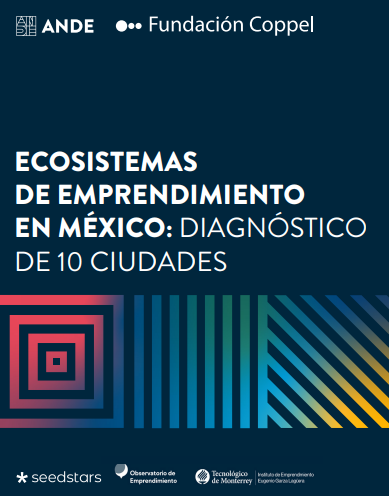
Las intervenciones más efectivas para fortalecer los ecosistemas emprendedores parten de un diagnóstico riguroso. Este reporte presenta una radiografía profunda de diez ciudades de México utilizando la metodología del Modelo para el Diagnóstico de Ecosistemas de Emprendimiento de ANDE (segunda edición).
El estudio analiza el nivel de madurez de cada ecosistema a través de siete dominios fundamentales: Política y Regulación, Financiamiento, Cultura, Servicios de Apoyo, Capital Humano, Mercados, e I+D e Innovación. Su propósito es ofrecer a tomadores de decisión un panorama regional comparativo que informe la priorización de recursos, identifique patrones comunes y detecte buenas prácticas transferibles entre ciudades.
Ciudades diagnosticadas en este reporte:
-
En Desarrollo: Guadalajara, Chihuahua y León.
-
Emergentes: Hermosillo, Ciudad Juárez, Mérida, San Luis Potosí y Zacatecas.
-
Nacientes: Oaxaca
Sizing the Impact Investing Market in Mexico
A collaborative project by ANDE, GIZ México y AIIMx
This study provides a comprehensive blueprint of the impact investing ecosystem in Mexico. With a market estimated between USD $1.7 and $2.2 billion in assets under management (AUM), the report analyzes 11 fundamental dimensions: from the characterization of the 130 identified stakeholders and their investment mechanisms, to the sectoral and geographic distribution of capital, impact measurement practices, and strategic opportunities for the sector’s growth.
An essential tool for investors, entrepreneurs, policymakers, and development organizations seeking to understand and strengthen the Mexican purpose-driven finance ecosystem.
The Indian Apparel and Textile sector is at an interesting crossroads as the Ministry has set ambitious targets for both international and domestic markets. As the Industry gears up to deliver on these targets, sustainability and circularity become an important lever for the growth and development of the sector. However, this development needs to account for the unique set up of the Indian industry and explore cluster level initiatives. This is the time for the industry to lead the narrative on sustainability and define the roadmap for a collaborative and sustainable development.
In partnership with the IKEA Foundation, ANDE launched the second phase of its initiative supporting green entrepreneurship in India and Kenya. The program seeks to help ensure a smooth transition to a greener, more inclusive economy in which green entrepreneurs can thrive and create good jobs. Through this partnership, ANDE conducted research on the green enterprise economy and brought together donors, investors, enterprise support organizations, policymakers, and entrepreneurs to identify and support solutions that help green enterprises in India and Kenya grow.
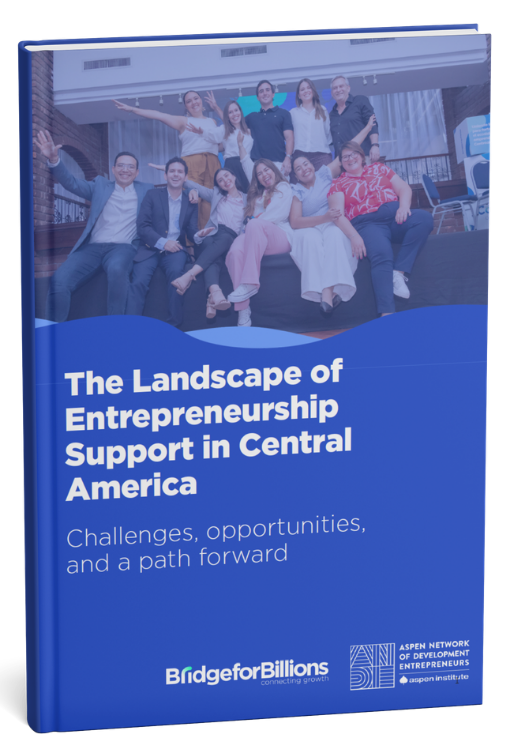 Central America’s entrepreneurship support ecosystem is vibrant yet structurally fragile. While ESOs demonstrate strong resilience—achieving a 75% program completion rate —they face chronic financial instability and fragmented coordination. This report reveals a significant capital gap, where only 36% of supported ventures secure follow-on funding. Concentrated in capital cities , the landscape requires a strategic shift toward sustainable financing and a regional association to unify the sector’s voice.
AUTHORS: ANDE & BRIDGE FOR BILLIONS
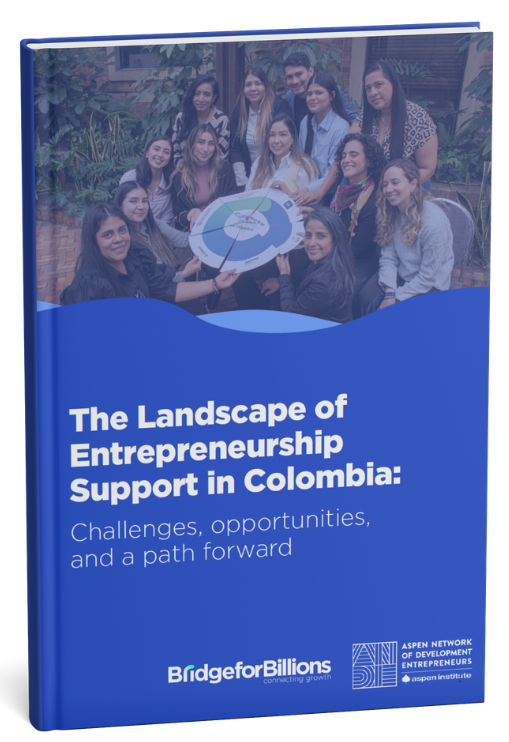 Colombia’s entrepreneurship support ecosystem is mature yet structurally imbalanced and financially fragile. While ESOs achieve high programmatic success with an 84% completion rate, they face a “scaling cliff” where support evaporates as ventures mature. This study reveals a critical capital chasm, as only 24% of graduates manage to secure external funding. Concentrated in the Andean region, the landscape requires a strategic shift toward sustainable, multi-year funding models. By adopting shared impact metrics, the sector can bridge the gap from incubation to real economic transformation. This report serves as a roadmap to strengthen Colombia’s investment-readiness and scaling pathways. AUTHORS: ANDE & BRIDGE FOR BILLIONS
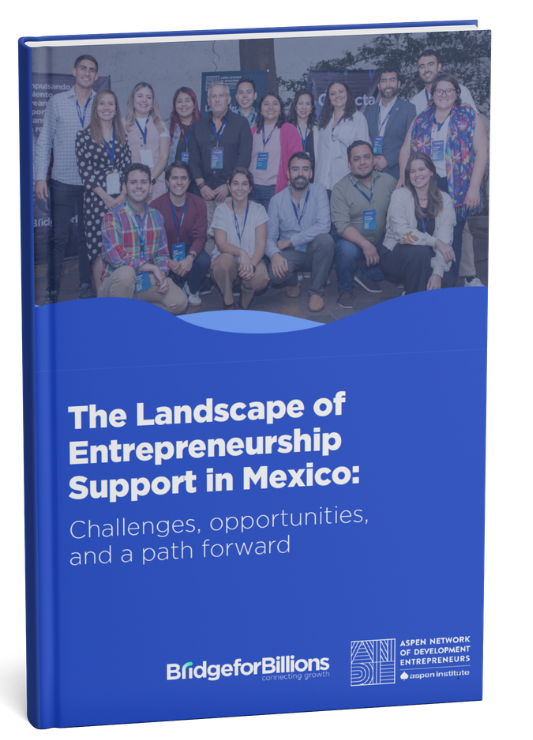
The ESO Excellence Report 2024: Mexico reveals a landscape of both resilience and fragility. While Mexican Entrepreneur Support Organizations (ESOs) are highly effective—achieving a 72% business survival rate and generating an average of 262 new jobs per cohort—they operate under chronic financial instability. This study uncovers a “hollowed-out middle” in the entrepreneurial pipeline and a severe capital desert, where only 27% of graduates manage to secure external funding. It serves as a strategic roadmap and a call to action for funders and policymakers to move toward sustainable, multi-year support models. AUTHORS: ANDE & BRIDGE FOR BILLIONS
 The ANDE Asia Annual Report 2025 highlights a year of collaboration, learning, and action across the region’s small and growing business (SGB) ecosystem. Amid evolving markets and increasing expectations around impact, inclusion, and climate outcomes, ANDE and its members continued to strengthen entrepreneurial ecosystems through practical capacity building, innovative programs, and strategic partnerships.
From flagship trainings like Investment Manager Training and SCALE 360 to member showcases, research dissemination, Access and Opportunity Learning Lab, and Climate and Environment Learning Lab, the report captures key milestones, member voices, and regional insights that shaped 2025. It also reflects on the collective progress made by ecosystem builders, investors, and partners working together to unlock capital, scale solutions, and drive inclusive economic growth—while setting the stage for deeper collaboration and impact in 2026.
This research explores the intersectional challenges affecting women micro-, small- and medium-sized entrepreneurs (MSMEs) in their access to financial products and services, and subsequent investment from financial institutions (FIs). Building on the previous studies of the challenges of women entrepreneurs (WEs) in accessing finance and gender lens investing landscape in Cambodia, this research further discusses intersectional approaches in examining the barriers to financial service by understanding the lived experiences of women MSMEs founders who come from different backgrounds. Using a Feminist Action Research methodology with 6 women entrepreneurs (1 woman with disability) as the lead data collectors, the study was conducted with 95 women MSMEs (2 LGBTQIA+, 10 women with disabilities) and 3 key informants in Phnom Penh and Battambang, between urban and rural demographics.
The study showed that diverse experiences and backgrounds of WEs – including age, ability status, religion, family composition, and sexual orientation – affect their access to financial services and expansion of their business activities. Emphasising the lived experiences of women entrepreneurs, a power dynamics analysis was conducted using the ‘Gender at Work’ tool to provide recommendations that would enable the products and services offered FIs to be designed in a way that enables diverse WEs to formalise, scale, and create impact, which also makes them more attractive as pipeline companies to investors. As the focus of this study was predominantly on the perceptions of WEs, it is recommended that studying FIs is a priority for future research to explore their initiatives and any gender-inclusive frameworks that address the intersectional experiences of WEs.